
Space Travel Time
- Product Definition
- Interaction Design
- Responsive Design
- Design System
- Data Modelling
- Front-End Build
What we're solving
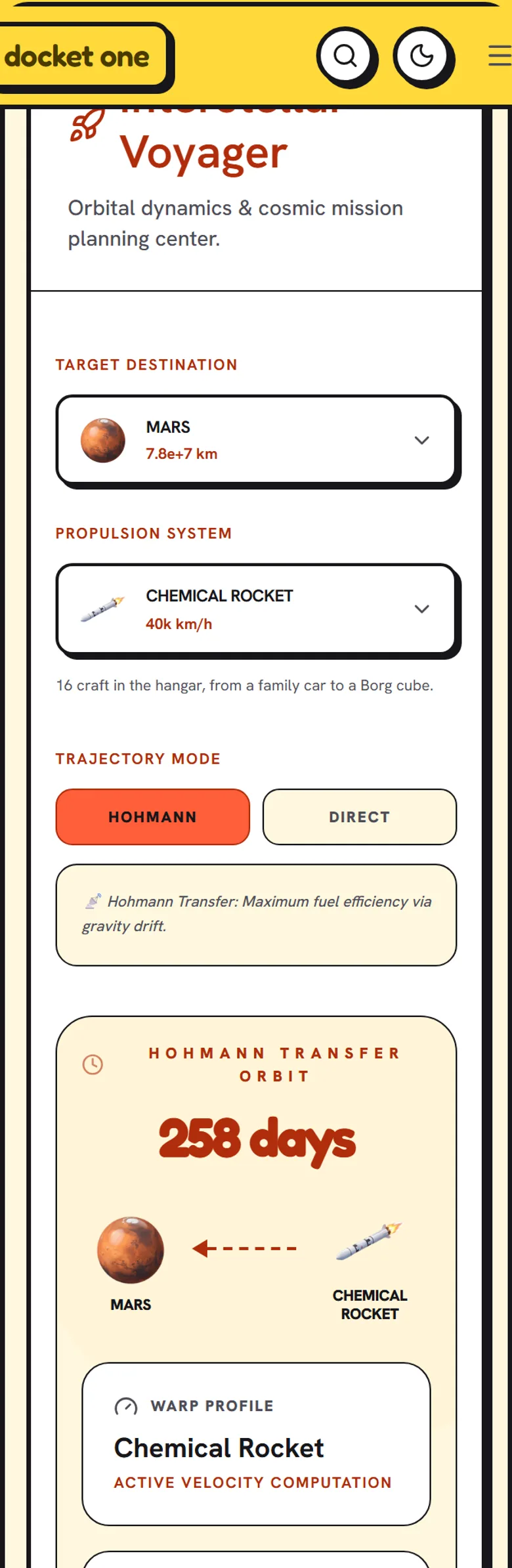
Space Travel Time is a shipped mission planner on Docket One. You pick a target, from the Moon out to the Andromeda Galaxy, pick something to fly there in, from a family car to a Borg cube, and it returns the journey time. The distances are real and so is the relativistic maths; nothing is looked up from a table.
Why it matters
Most sources answer how long it takes to reach Mars with one number, and never say what that number assumed. Change the trajectory and it moves by months, because a fuel-efficient Hohmann transfer is nothing like a straight line. Read the crew's clock instead of mission control's and it moves again once you are near light speed. So one question has two correct answers, and the page has to carry both without reading like a physics lesson.
How we got there
Where the existing answers fail: Existing travel-time calculators return one figure and hide the two variables that actually move it. The number is presented as a fact when it is the output of assumptions the reader never sees.
Two audiences, one page: The traffic splits between people following a curiosity, usually from science fiction, and people checking a figure for something they are writing or teaching. Both groups want the number quickly, and only the second group stays for the reasoning. That ruled out a step-by-step wizard.
Who this is for
Anyone who has just wondered how far away something really is. In practice that splits into people arriving from science fiction who want the scale made concrete, and people who need a defensible figure for a lesson, a script or an article.
Meet the users

The rabbit-hole reader
Came from a thread about generation ships and wants to know whether the premise holds up. Representative rather than interviewed.
- Age:
- 24
- Location:
- Bristol
- Occupation:
- Software Support
Goals
- Get a number for Proxima Centauri without reading a paper first
- Try the ridiculous options, because that is where the scale lands
- Understand why the crew's answer differs from ours
Frustrations
Most sources give one figure with no way to see what it assumed, so there is nothing to poke at.

The person who has to be right
Writing a lesson plan and needs a figure that will survive a clever student asking where it came from. Representative rather than interviewed.
- Age:
- 41
- Location:
- Leeds
- Occupation:
- Physics Teacher
Goals
- See which trajectory the number assumes, and change it
- Show two clocks disagreeing without deriving Lorentz on a whiteboard
Frustrations
Calculators that print a single unexplained number are unusable in a classroom, because the first question is always how it was worked out.
What they need to do
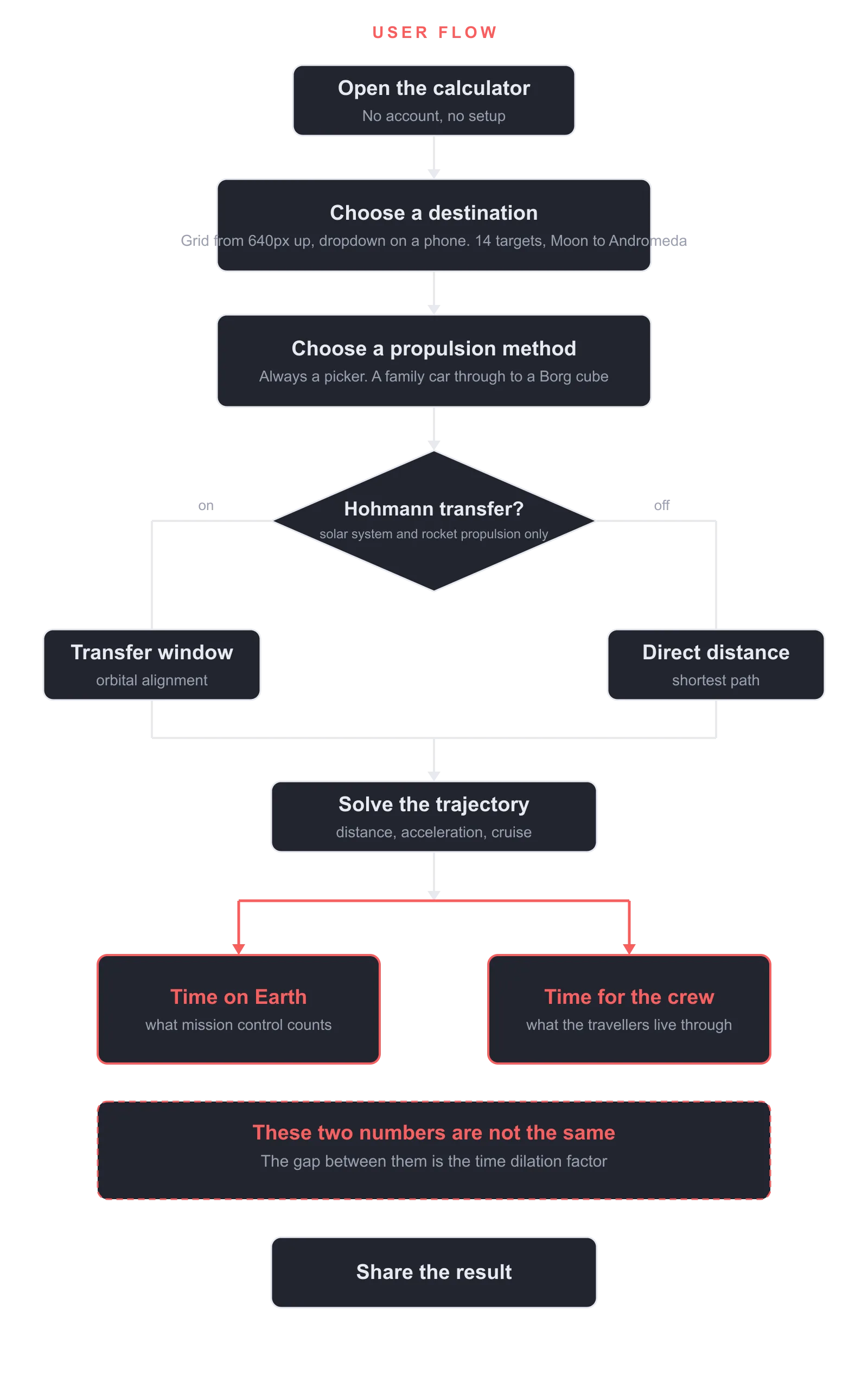
- Pick a destination
- Pick something to travel in
- Switch between a transfer orbit and a direct route
- Read the time as measured from Earth
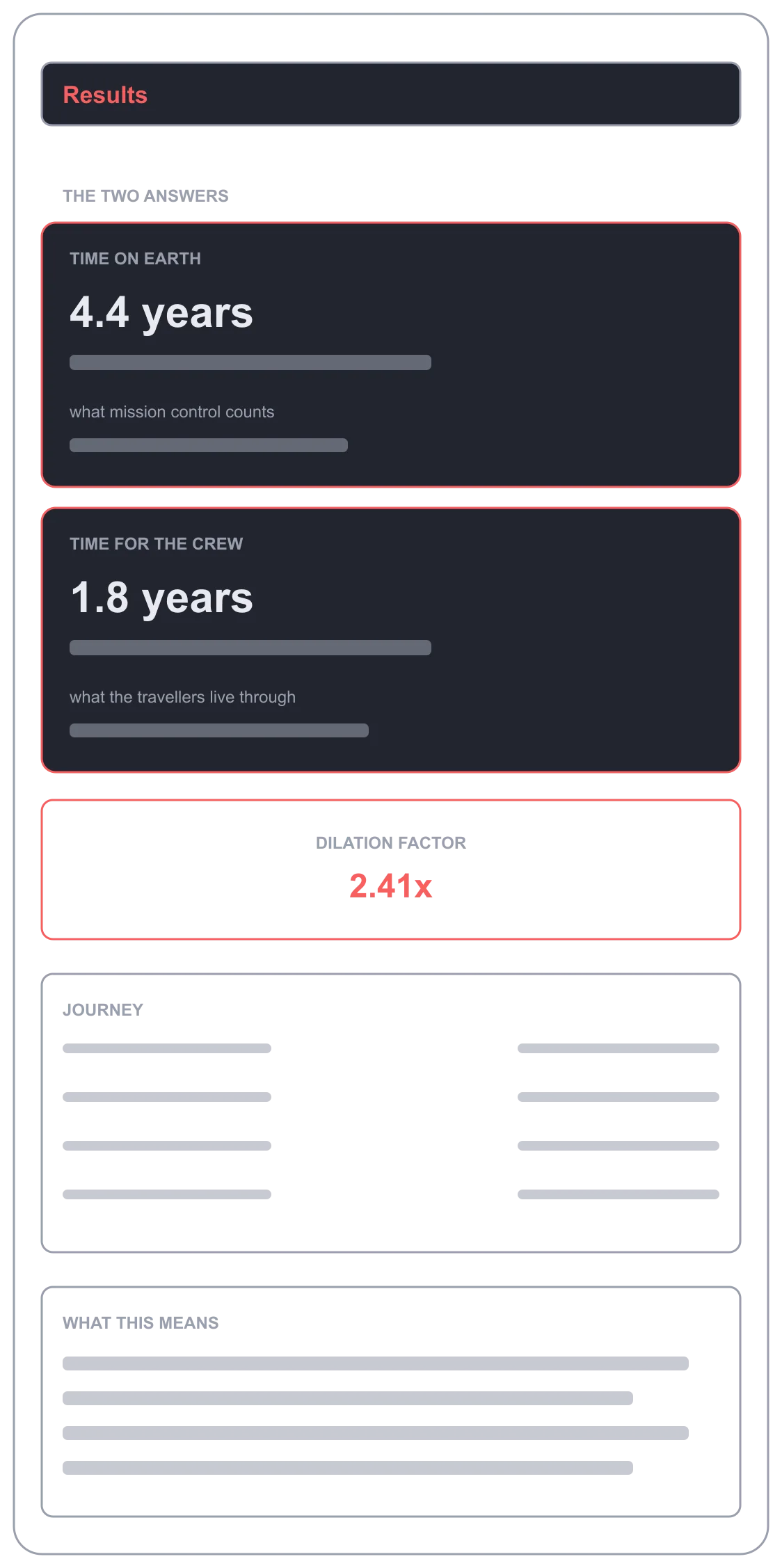
- Read the time as experienced by the crew
- See how far apart those two are
- Share the result
Mapping the journey
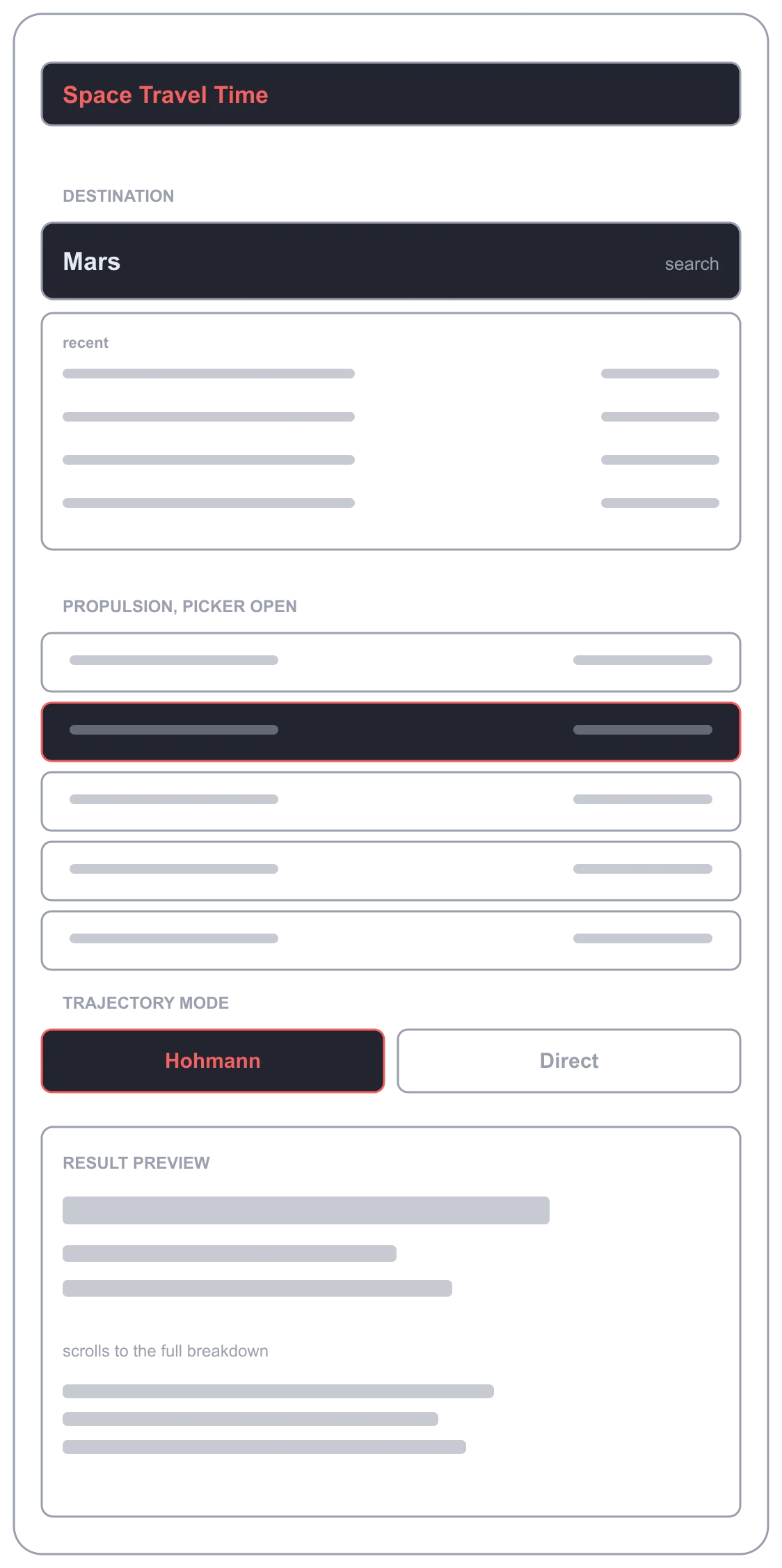
Sketching the structure
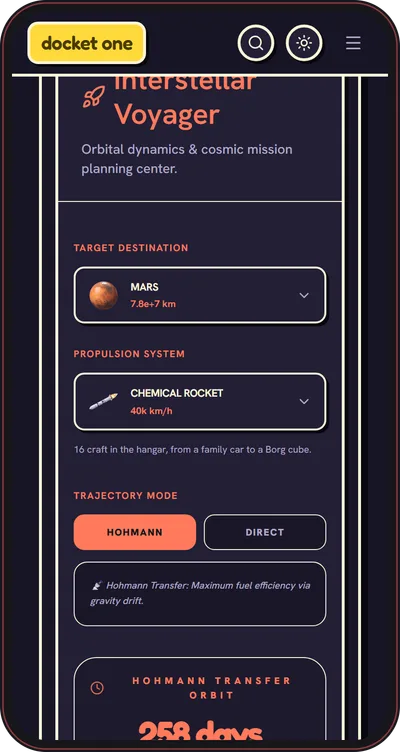
The finished experience